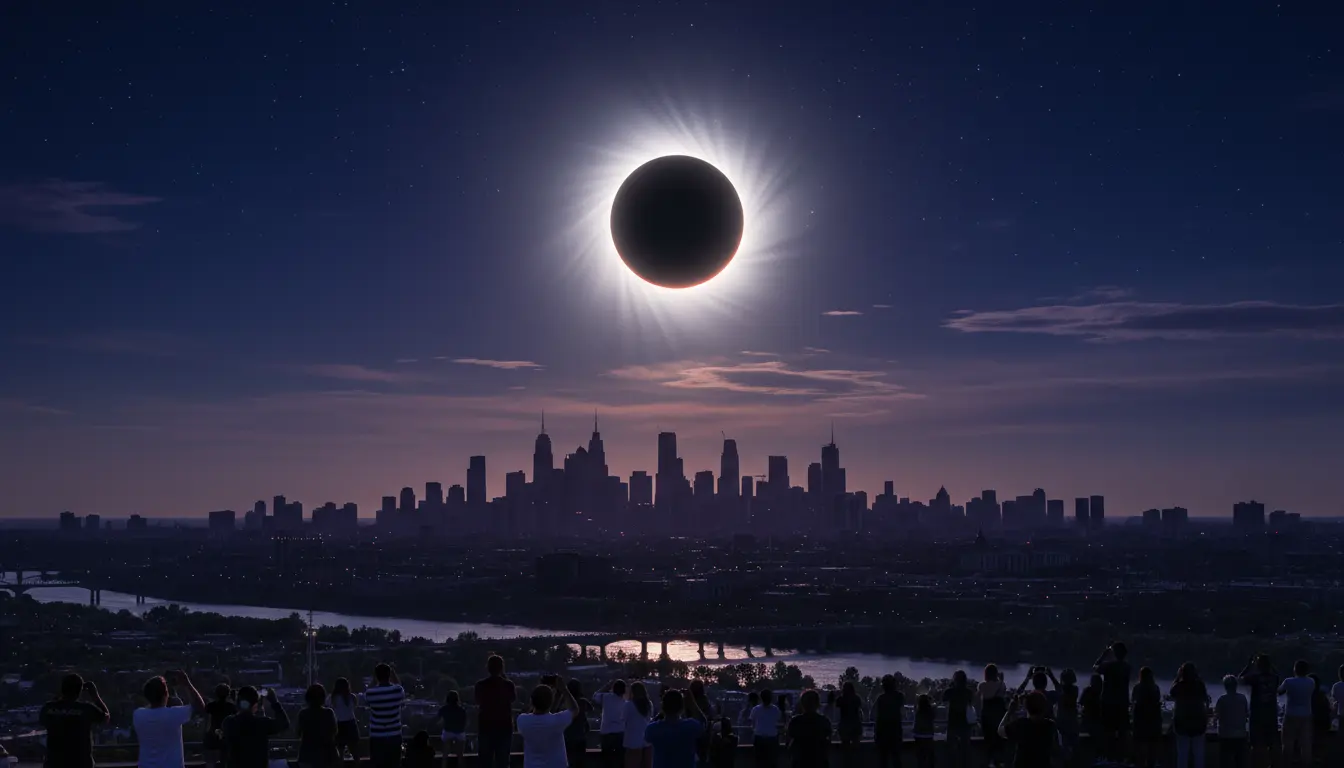
The 2027 eclipse is one of the rare astronomical events that can be planned for in advance. This guide explains when and where to see it, how to prepare, safety rules, and simple planning tips so you do not miss totality.
When Day Becomes Night: 2027 Eclipse Overview
The solar eclipse in 2027 will be a total solar eclipse on August 2, 2027. During totality the Moon will fully cover the Sun and daylight will briefly fall into deep twilight.
People along the path of totality will see the Sun’s corona and experience a dramatic drop in light and temperature. Regions outside the path will still see a partial eclipse.
What to expect during the 2027 eclipse
Expect a sequence of phases: a long partial phase, a short period of totality, then another partial phase as the Sun reappears. The full event can take a few hours from first to last contact, though totality lasts only minutes.
Where to See the 2027 Eclipse
The path of totality will cross portions of northern Africa and the Middle East. Many populated locations near the path will be prime viewing spots.
Choose a viewing site well inside the path to maximize the length of totality and reduce the chance of being outside the line of totality due to small location errors.
How to choose a viewing location
- Check local weather statistics for August to pick a location with historically low cloud cover.
- Avoid urban centers with heavy light pollution if you want sky visibility before and after totality.
- Plan for transportation and lodging early; popular towns can sell out months in advance.
How to Prepare for the 2027 Eclipse
Preparation is mostly logistical: travel, safety, and equipment. Follow clear steps so your day is focused on the experience, not last-minute problems.
Essential checklist for viewing the 2027 eclipse
- Valid travel documents and well-located accommodation booked early.
- ISO-certified solar eclipse glasses (ISO 12312-2) for all observers.
- Solar filters for cameras, binoculars, and telescopes.
- Portable chair, water, sun protection, and snacks for long waits outside.
- Backup plan for weather: a nearby alternate site within range.
Safety: How to View the 2027 Eclipse Correctly
Nevetheless, safety must be your top priority. Viewing the Sun without proper protection can cause permanent eye damage.
Practical safety rules
- Use ISO-certified eclipse glasses whenever any part of the Sun is visible. Regular sunglasses are not safe.
- Use solar filters on any optical device. Remove filters only during totality when the Sun is fully covered, and replace them immediately when totality ends.
- Supervise children closely and keep them wearing approved protection until the Sun is fully covered.
During totality the Sun’s outer atmosphere, the corona, becomes visible. The corona is normally hidden by the bright disk of the Sun and can only be seen safely during totality.
Photography and Timing Tips for the 2027 Eclipse
If you plan to photograph the eclipse, practice ahead of time. Solar photography requires filters and careful exposure control.
Simple photo setup
- Use a tripod and a remote shutter to avoid camera shake.
- Attach a solar filter to the lens for partial phases and remove it only during totality.
- Bracket exposures during totality to capture the corona (take multiple exposures from short to long).
Real-World Example: Lessons from the 2017 U.S. Eclipse
When the U.S. experienced a total solar eclipse in 2017, small towns along the path saw sudden surges of visitors. Hotels and roads were full weeks ahead of the event, and local services adapted quickly.
Lesson: book lodging and transport early, expect heavy traffic on the day, and coordinate arrival at least a day ahead of totality to avoid last-minute delays.
Final Planning Steps for the 2027 Eclipse
Start with these practical actions three to six months before the event: select your viewing town, book travel and lodging, and buy certified safety glasses and any camera filters you need.
On the day, arrive early, test your equipment under the Sun, follow safety rules strictly, and have patience. The minutes of totality are the reward for careful planning.
Quick timeline for the final month
- 6–3 months: Reserve lodging and transportation. Research weather and alternate sites.
- 3–1 months: Buy safety gear, solar filters, and test camera settings.
- 1 week: Confirm travel details and print or download maps and timing charts local to your viewing spot.
With preparation and safety, the 2027 eclipse will be a memory you can relive for years. Plan early and focus on the experience: when day becomes night, you want to be watching, not worrying.